REVIEW · CITY TOURS
Jaipur@Twilight Guided Heritage City walk tour with Food Tasting
Book on Viator →Operated by Seagull Jaunt · Bookable on Viator
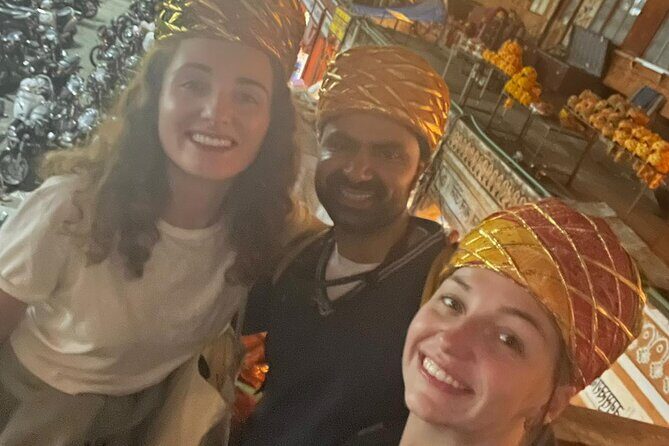
Twilight turns Jaipur into a living story. This guided walk nails the twilight glow and mixes street-level culture with hands-on craft, including marble statue work and small-group time to look closely. I especially loved seeing the statue-making steps unfold, and I was equally drawn to the bangle-market energy where lac bangle-making is part of the experience. One thing to consider: it’s still a market-area walk at night, so wear comfy shoes and expect crowded lanes.
If you like connecting art, food, and everyday life, this tour does a good job of linking the dots. I also liked how the guide team (I worked with Umesh) stayed flexible with timing when asked, so you don’t feel boxed in if your day runs late.
The pace is built for a 2.5-3 hour evening: plenty of short stops, plus a ride toward the finish. You’ll use a mobile ticket, and the group stays capped at 10 travelers.
In This Review
- Quick hits: what makes this Jaipur twilight walk worth your time
- Twilight in Jaipur: what changes when the lights come on
- Starting at Raj Mandir and settling into a 2.5 to 3 hour evening rhythm
- Khajane Walon Ka Rasta and Khejado Ka Rasta: marble statue making up close
- Tripolia Bazar at Thakur Uday Singh Ji Haveli: miniature art and older lamps
- Maniharon ka rasta: bangle-making, lac bangles, and bridal jewelry scenes
- Johri Bazaar to the Pickle Man: sweet tasting plus a 195-year shop
- E-rickshaw to Albert Hall Museum: the night-view finish in Ram Niwas Garden
- Price and value: what $29.96 buys you in craft access and food
- Who should book this twilight walk, and who should skip it
- Should you book Jaipur@Twilight Guided Heritage City walk with Food Tasting?
- FAQ
- How long is the Jaipur twilight guided heritage walk?
- Where does the tour start and where does it end?
- What is the price per person?
- Is there a food tasting included?
- Is Albert Hall Museum admission included?
- What’s the group size limit?
- What happens if the weather is poor or I need to cancel?
Quick hits: what makes this Jaipur twilight walk worth your time
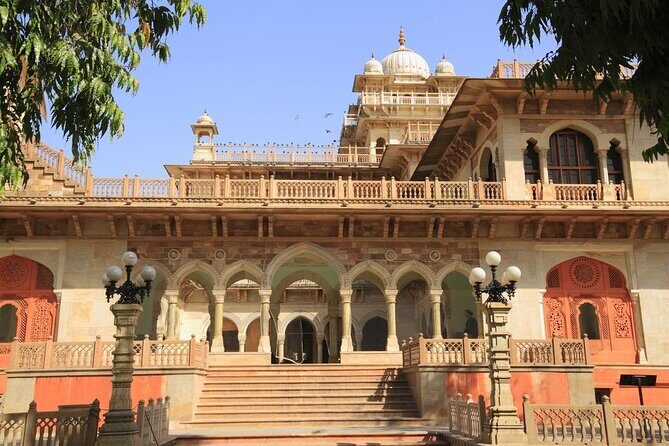
- Marble statue making from sketch to final painting at the statue-making lanes
- Thakur Uday Singh Ji Haveli with miniature wall art and older-style gas lamps
- Lac bangle-making at the bangle market street, with bridal jewelry sights
- Johri Bazaar sweet tasting followed by the Pickle Man of India and a 195-year shop
- E-rickshaw transfer to Albert Hall Museum for the night-view finale at Ram Niwas Garden
Twilight in Jaipur: what changes when the lights come on
Jaipur at dusk feels like two places at once. Daylight still holds the colors in the stone and buildings, but night lamps start switching on, and the markets become more than just shopping streets.
That shift matters on a walking tour. In daylight, you notice shape and layout. In twilight, you notice the mood—warm lamp light bouncing off shopfronts, glowing signage, and the “busy but working” feeling of craft lanes. This tour is designed around that moment when Jaipur looks lively without being fully night-chaos.
I like that the route includes multiple artisan-focused stops, not just viewpoints. When you see craft processes in the evening, the details feel more immediate—like you’re watching the city at work, not just looking at it.
You can also read our reviews of more walking tours in Jaipur



Starting at Raj Mandir and settling into a 2.5 to 3 hour evening rhythm
Your meeting point is Raj Mandir Cinema on Bhagwan Das Road in the C Scheme area (Panch Batti). That’s a handy start for first-time visitors because it anchors you near a well-known landmark and keeps the tour easy to find.
The walk runs about 2 hours 30 minutes to 3 hours, with frequent short stops. That’s a practical sweet spot: you get enough time to visit several craft streets and markets, plus food tasting, without turning your evening into a long slog. Since the group is capped at 10 travelers, you’re less likely to feel like you’re moving through a human wave.
Also, there’s a built-in transport moment near the end. You’ll use an e-rickshaw to reach Albert Hall Museum, which helps you conserve energy for the final stretch.
Khajane Walon Ka Rasta and Khejado Ka Rasta: marble statue making up close
The tour begins by moving toward Khajane Walon Ka Rasta via Khejado Ka Rasta—known for its statue-making craft. This is one of the most memorable parts because you’re not just seeing finished marble pieces. You’re watching the process itself.
Plan on spending around 35 minutes here. You’ll get to see statue work from sketch to final painting on marble statues. That “from start to finish” approach is rare in short city walks, and it gives you a real appreciation for the skill behind the display.
A nice extra is the contrast the experience highlights between art traditions. The tour also points out gold work on marble statues and artifacts, plus the way Indian and European art styles can show up side-by-side in the final look. Even if you don’t know art terminology, you’ll get the visual message quickly: this isn’t mass production, and it’s not one-style-only craftsmanship.
Practical tip: bring your phone camera, but also take a moment with your eyes first. The best details here are in small steps—tool marks, paint layering, and how the final finish sits on marble.
Tripolia Bazar at Thakur Uday Singh Ji Haveli: miniature art and older lamps
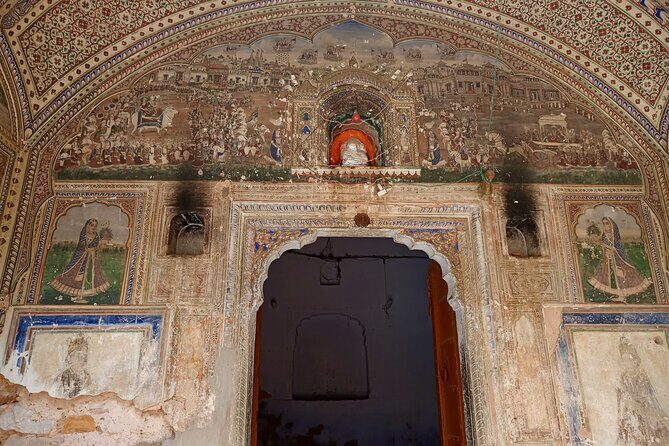
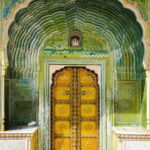
Next comes Tripolia Bazar, where you visit Thakur Uday Singh Ji Haveli. This is a change of pace from street craft. Instead of outdoor market noise, you get a look at a historic mansion setting, where art appears as wall paintings and interior features.
You’ll spend about 15 minutes at the haveli, with admission included (the stop is marked as free). The big draw for me is the mix of styles and details mentioned for this specific place: miniature art wall paintings and British empire time gas lamps for lighting at night, plus a vintage car you can explore during your visit.
Twilight is especially good here. Those older-style lamps and the warm lighting effect make the haveli feel more atmospheric than it might in flat daylight. It also adds to the tour’s theme of seeing Jaipur through multiple eras, not just one.
Downside to know: the stop is short. If you’re the type who wants 30-45 minutes to wander slowly and take many photos, you’ll feel a bit time-pressured. Still, for a guided evening walk, it’s a solid dose.
Maniharon ka rasta: bangle-making, lac bangles, and bridal jewelry scenes
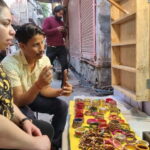
Then you head toward Maniharon ka rasta, another area tied to a craft name. “Manihara” points directly to the world of bangles and jewelry, and the street reflects it—color, display, and lots of bridal-focused pieces.
You’ll get about 15 minutes here. The tour experience highlights lac bangle-making, and it also points out the presence of artificial jewelry for bride and collections of intricate Indian designs. In twilight, these streets tend to look even more dramatic because light catches glassy surfaces, metal accents, and the dense stacking of bangles.
I like this stop because it’s visual even if you don’t know the technical process. You’ll be able to connect what you saw earlier—materials, carving, painting—to how artisans build beauty in another form. Bangles are wearable art, and the bridal context makes the craftsmanship feel purposeful.
Practical tip: don’t assume you’ll be able to shop freely and chat with everyone. This is still a working market lane, and traffic can build up. Treat the stop as a look-and-learn segment unless you’re ready to browse quickly.
You can also read our reviews of more food & drink experiences in Jaipur





Johri Bazaar to the Pickle Man: sweet tasting plus a 195-year shop
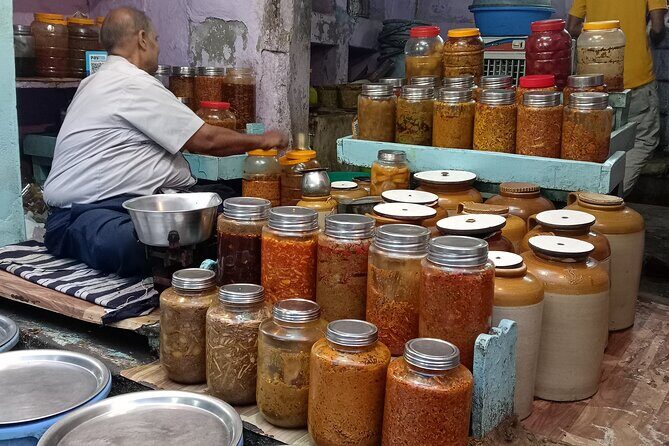
After that, the tour shifts to food and flavor. You start with sweet dishes tasting, then continue through Johri Bazaar into nearby lanes such as Gopal Ji Ka Rasta and Achar Wali Gali.
This stretch is about 40 minutes, and it’s one of the best sections for breaking up the craft-heavy first half of the walk. Food tasting also makes the stories stick. Instead of only hearing about traditions, you get a taste you can remember later.
One standout here is meeting the Pickle Man of India, described as being awarded by Discovery Channel, and visiting a 195-year-old shop of pickles. That’s not just a trivia detail—it signals how long this shop has been serving the same kind of preserved-food culture. Preserving food is a craft too, and the spice-and-time logic is part of how Indian markets work.
What to expect in the real world: you’ll likely smell spices and see rows of colorful jars as you walk in the lane atmosphere. Sampling might depend on how the tasting is arranged, but the tour clearly includes sweet-food tasting, and the pickle stop is part of the guided experience.
E-rickshaw to Albert Hall Museum: the night-view finish in Ram Niwas Garden
The final leg uses an e-rickshaw to move toward Albert Hall Museum. This is a smart design choice because it keeps the last stretch from being pure foot fatigue.
You’ll also get night views of Jaipur market areas as you travel. That matters because the evening experience is about seeing the city glow in motion—shop fronts, street lights, and the feeling of Jaipur after work and before bedtime.
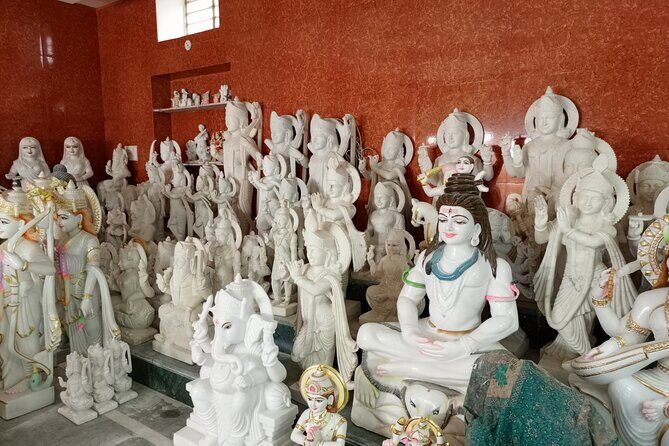
Your museum time is about 30 minutes, and the tour focuses on the garden area and museum lighting. The Albert Hall Museum admission ticket is not included, so if you want to go inside the museum galleries, you’ll need to plan for separate entry.
Practical tip: if you care about photos, arrive ready to pause. Garden lighting and facade lights can look best from the edges where you’re not competing with crowds.
Price and value: what $29.96 buys you in craft access and food
At $29.96 per person, this tour is priced like a value evening activity rather than a premium private experience. And for what’s included, it can make sense—especially if you’re only in Jaipur for a short time.
Here’s the value logic I see:
- You get guided access to multiple craft and market stops in a tight time window.
- Several stops are marked with free admission tickets in the schedule details.
- You get food tasting as part of the experience, not something you have to hunt for on your own.
- You also get the e-rickshaw transfer for the finale.
- The only major ticket note is that Albert Hall Museum admission is not included.
So you’re paying mainly for the organization and guided storytelling, plus the small transport relief at the end. If you try to DIY this exact route alone, you might still see markets—but you’d miss some of the “process” focus, like the statue-making steps from sketch to final painting.
Also, with a maximum of 10 travelers, you’re more likely to ask questions and get answers while you’re standing in the lanes—rather than shouting to be heard.
Who should book this twilight walk, and who should skip it
This tour fits best if you:
- Want craft-focused Jaipur (statues, bangles, and jewelry) rather than only monuments
- Like evenings and want a route that’s paced for twilight
- Enjoy food tastings that connect to market culture
- Prefer small groups and a guided flow that reduces planning work
I’d be cautious if you:
- Have trouble with walking or crowded lanes at night
- Are uncomfortable in market-style environments where shops and people are close together
- Expect a long, museum-heavy program inside Albert Hall Museum (the tour’s museum portion is mainly about night views and garden lighting, and entry isn’t included)
If you’re unsure, this is exactly the kind of activity you book when you want a “do more with less planning” evening—and you want Jaipur’s craft lanes to be the star.
Should you book Jaipur@Twilight Guided Heritage City walk with Food Tasting?
Yes, book it if you want a compact, evening-friendly way to see Jaipur craft culture through hands-on processes, not just storefront photos. The statue-making focus, bangle-market atmosphere, and the addition of sweet tasting (plus the pickle landmark) give you multiple angles of the city in one evening.
Skip it or choose another option if you hate night crowds or you need a very low-walking plan. And if museum time inside Albert Hall is a must for you, plan for separate entry since admission is not included.
If you can, come dressed for comfort and move with the crowd at a calm pace. This tour works best when you let the lanes slow you down just enough to notice the details.
FAQ
How long is the Jaipur twilight guided heritage walk?
It lasts about 2 hours 30 minutes to 3 hours.
Where does the tour start and where does it end?
It starts at Raj Mandir Cinema, C-16, Bhagwan Das Rd, Panch Batti, C Scheme, Ashok Nagar, Jaipur, and ends at Albert Hall Museum in Ram Niwas Garden.
What is the price per person?
The price is $29.96 per person.
Is there a food tasting included?
Yes. The tour includes a food tasting experience with authentic Indian flavors, and sweet dishes are mentioned as part of the tasting along the route.
Is Albert Hall Museum admission included?
No. Albert Hall Museum admission is marked as not included.
What’s the group size limit?
The maximum group size is 10 travelers.
What happens if the weather is poor or I need to cancel?
The tour requires good weather. If it’s canceled due to poor weather, you’ll be offered a different date or a full refund. For cancellations, you can cancel up to 24 hours in advance for a full refund.