REVIEW · CITY TOURS
Jaipur City Tour with Traditional Flower Market Visit
Book on Viator →Operated by Rajasthan India Tour Driver · Bookable on Viator
Jaipur hits different when you’re on the ground all day, not just hopping between stops. This tour pairs a private AC car with a local guide, then starts with a morning flower market walk and chai. The driver Vinod is consistently described as helpful, friendly, and professional, which matters when the day is packed.
I also like the mix of famous monuments and places that feel more local, like Panna Meena Ka Kund and the tea-stop snack culture. One thing to plan for: the big monument entrance fees aren’t included, so your day costs a bit more than the headline price.
In This Review
- Key highlights at a glance
- Private AC Jaipur: why this format works
- The 7:00–8:00 flower market walk (and how it shapes the morning)
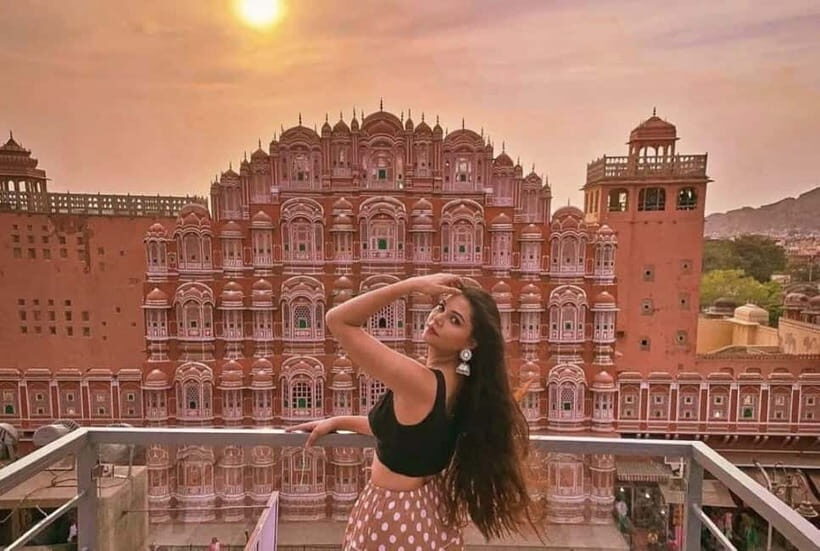
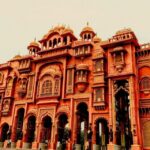
- Hawa Mahal: fast photo stop, then the full story
- Amer: palaces, carvings, and Mughal-Rajput blend
- Panna Meena Ka Kund: a stepwell that feels like a quiet secret
- Jal Mahal views: the palace in the lake
- Royal Gaitor: cenotaphs with real carving detail
- City Palace and the old city walls: where the royal story continues
- Jantar Mantar: astronomy tools that look like art
- Isarlat (Sargasuli) Tower: panoramic views for the patient
- Albert Hall Museum: architecture stop with a museum inside
- Galta Ji Temple: a pilgrimage site with spring water
- Optional Jaipur markets after sightseeing: shop with a local route
- Price and value: $13.59 per group plus monument entrances
- Pace, comfort, and what to expect during the day
- Who should book this Jaipur tour, and who should skip it
- Should you book it?
- FAQ
- What’s the meeting point for this tour?
- Is pickup and drop-off included?
- Does the tour include the flower market visit?
- How long is the Jaipur city tour?
- What’s included in the price?
- Are monument entrance fees included?
- What if the weather is poor?
Key highlights at a glance
- Morning flower & vegetable market walk (7:00–8:00 slot) with a guided route from Hawa Mahal
- Driver Vinod-style hosting: friendly, attentive, and good at keeping your day on track
- Big-name sights plus offbeat stops like Panna Meena Ka Kund and Royal Gaitor
- One structured day covering Amer, Jal Mahal views, City Palace, Jantar Mantar, and Galta Ji
- Optional market shopping after sightseeing for fabrics, sandals, bags, and more
- Budget for entrances: combined monument fees are extra per person
Private AC Jaipur: why this format works
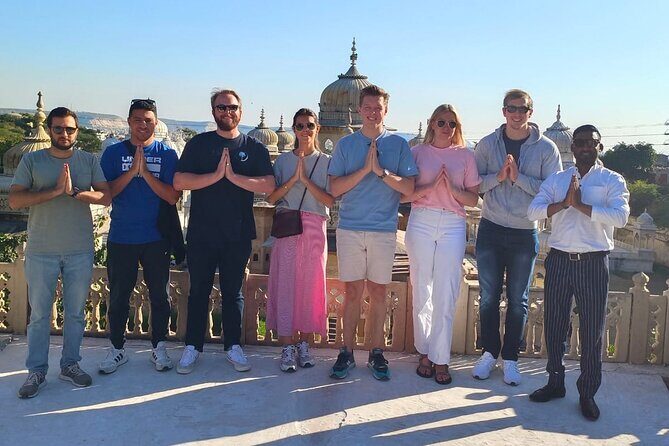
Jaipur’s sights are spread out, and public transport can turn a “full day” into a “half-day of commuting.” This tour is built around a private air-conditioned car, so you can actually see things instead of negotiating schedules, waiting, and routes.
The other smart piece is the human layer: you get a local guide and a driver who handles the driving and pacing. When you’re walking through crowded markets or moving between monuments, having someone who knows where to go and what to focus on makes the experience smoother. Based on the positive feedback about Vinod, expect a calmer day—less stress, more moments where you can ask questions.
Plan on a long outing: about 9 to 10 hours. That’s not a drawback by itself, but it does affect how you pack your day—start comfortable, wear good shoes, and don’t try to squeeze in extra plans before or after.
You can also read our reviews of more city tours in Jaipur

The 7:00–8:00 flower market walk (and how it shapes the morning)

If you choose the 7:00 AM to 8:00 AM time slot, your morning begins with a trip to the flower & vegetable market. The tour does two helpful things right away:
1) You get a photo opportunity at Hawa Mahal before you start walking.
2) Then you walk into the market area and learn the local way of selling flowers and vegetables.
This is one of the best uses of time in Jaipur because it’s early and it’s specific. Late mornings tend to feel more like sightseeing. A morning market walk gives you real texture—how people set up, how they talk, and how the day’s supply moves. You’ll also pass an 18th-century heritage building on the way, which adds history without making it feel like a lecture.
After the market visit, you head to some older local food stores for masala chai plus snacks like samosa or kachori. This part is small, but it’s where the day becomes memorable. Jaipur can be visually overwhelming, and a warm pause with simple food helps your brain reset before forts and palaces.
Practical tip: If you pick the market slot, bring a light layer. Mornings can feel cooler than the midday heat, especially while you’re walking.
Hawa Mahal: fast photo stop, then the full story
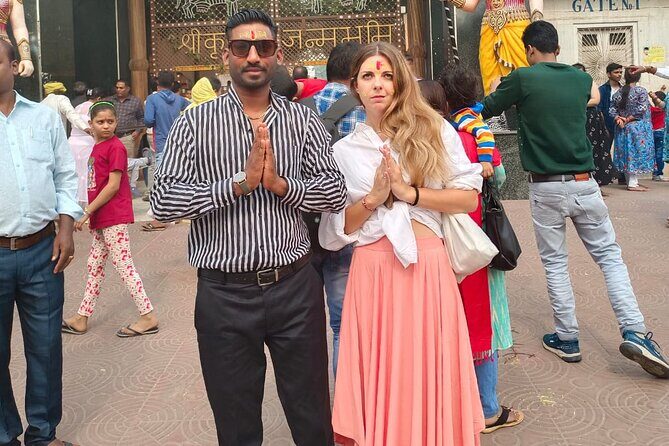
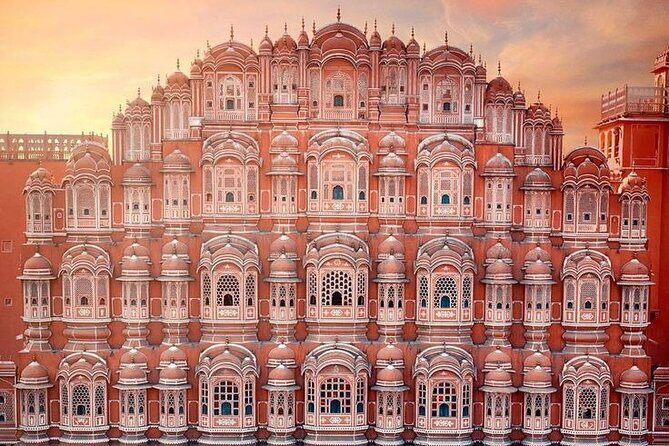
Hawa Mahal (Wind Palace) is famous for a reason, but most people only see it from the outside. This tour uses it in two phases: first for a photo moment, later as a formal sightseeing stop.
Here’s what makes it worth lingering on:
- It’s a five-story building dedicated to Lord Krishna.
- It was built in a way that’s often described as unusual for its stability—tallest without a foundation, with a curved structure that leans at an 87-degree angle, plus a pyramidal shape that helped it stay standing for centuries.
Even if you’ve seen photos before, looking at the façade up close changes the feel. The “wind palace” idea connects architecture to function, and the way the design repeats across levels makes it easier to understand why it became an icon.
Also, don’t rush it. Jaipur’s best moments are often the ones where you stop and let the details land: windows, carved stone rhythms, and the sheer height against the sky.
Amer: palaces, carvings, and Mughal-Rajput blend
Amer is a strong early stop because it gives you a sense of Rajasthan’s royal world without feeling like a separate day trip. Amer is about 11 kilometers from Jaipur, and it’s known for its blend of Mughal and Rajput architecture.
Key highlights you’ll encounter include:
- Sheesh Mahal (Mirror Palace)
- Sila Devi Temple
- Palaces, temples, and intricate carvings tied to the royal past
Amer works especially well with a guide because it’s not just “big building, pretty view.” The architecture is the point, and the details are what your eyes will start craving after a few stops. If you like to understand why things were built a certain way, Amer is where the tour can start feeling richer and more meaningful.
Consideration: Amer involves walking around uneven spaces. You don’t need to be an athlete, but you do want comfortable shoes and a pace that doesn’t punish your feet.
Panna Meena Ka Kund: a stepwell that feels like a quiet secret
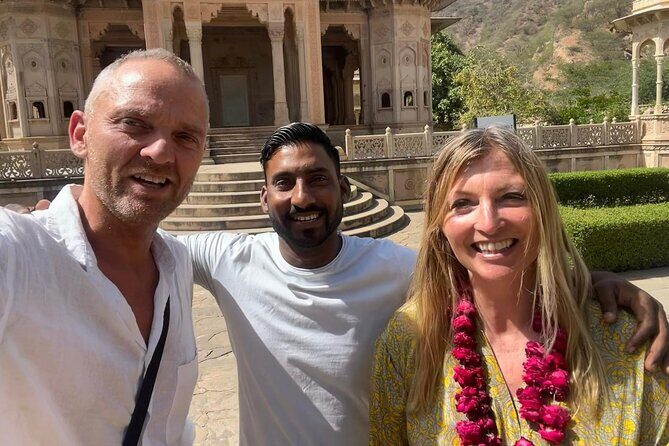
After Amer, you’ll visit Panna Meena Ka Kund, described as a hidden gem. The stepwell is a 16th-century structure and sits in the shadow of a fortress nearby. That setting matters: it can feel cooler and more shaded than the open-city monuments.
Stepwells in Rajasthan aren’t just “old wells.” They’re engineering for water, built for daily life, and often tied to social and religious use. Even if you don’t go in expecting to learn everything, you’ll still appreciate the scale and the geometry—steps that turn a functional place into a visual one.
This stop is also a good contrast after Amer. It gives your day a different rhythm: less palace drama, more quiet structure.
You can also read our reviews of more shopping tours in Jaipur






Jal Mahal views: the palace in the lake
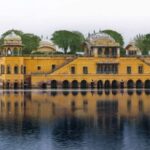
Next comes Jal Mahal, a palace located in the middle of Man Sagar Lake. You may not spend ages inside if your schedule is packed, but even the viewpoint helps. The unusual location makes Jal Mahal easy to photograph and hard to ignore.
This is also where the tour naturally transitions from fortress-town vibe back into Jaipur’s city monuments. It’s a “pause in the scenery” stop, and that matters on a long day.
Royal Gaitor: cenotaphs with real carving detail
Then you head to Royal Gaitor, located on the Nahargarh foothills. Royal Gaitor is described as a restful place, but don’t let that fool you—this is about stone monuments and memory.
What you’re looking at includes:
- Cenotaphs of Maharaja Pratap Singh, Madho Singh II, and Jai Singh II
- The stone monuments’ intricate carving and display style
- The most impressive marble cenotaph is said to have a dome supported by 20 carved pillars (attributed to Maharaja Jai Singh II)
If you like monuments that feel more “lived-in by craftsmanship” than “grand for crowds,” Royal Gaitor is often a highlight. It’s also a helpful break from the heaviest crowds.
City Palace and the old city walls: where the royal story continues
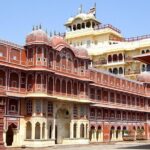
The tour then turns deeper into the walled city area for City Palace. The complex was conceived and built by Maharaja Sawai Jai Singh II, founder of Jaipur, and it’s a mix of Mughal and Rajput architecture.
One detail that makes City Palace more interesting than a typical sightseeing stop: it’s still connected to the royal family. The complex is home to the last ruling royal family, with a private section that you can’t treat like a museum open to everything.
This matters because it gives you a sense of continuity. You’re not just looking at an artifact; you’re looking at a living place organized around tradition.
Practical tip: Expect to spend meaningful time here if you want photos and time to read architectural cues. If you’re moving fast, you can still enjoy it—but you’ll skim the best parts.
Jantar Mantar: astronomy tools that look like art
Jaipur’s Jantar Mantar is an early 18th-century astronomical observation site. It includes about 20 main fixed instruments.
What I like about this stop is that it doesn’t feel like a dusty lecture. The shapes look like sculpture, but they’re tools. A good guide helps you understand what you’re seeing—how the instruments are arranged and what they’re meant to measure.
If you enjoy the intersection of science and design, this is one of Jaipur’s best “wow, but explain it” experiences.
Isarlat (Sargasuli) Tower: panoramic views for the patient
Next, you visit Isarlat or Sargasuli Tower, a seven-storied monument built in 1749 by Sawai Ishwari Singh. You can experience panoramic views from atop the tower.
This is where you slow down, even if you’re a fast traveler. Views are only worth it if you stop long enough to look beyond the obvious. From the top, Jaipur’s geometry starts making more sense—how the fortifications and neighborhoods relate.
Consideration: Towers mean steps. If your plan includes lots of walking elsewhere in the day, protect your energy for this one.
Albert Hall Museum: architecture stop with a museum inside
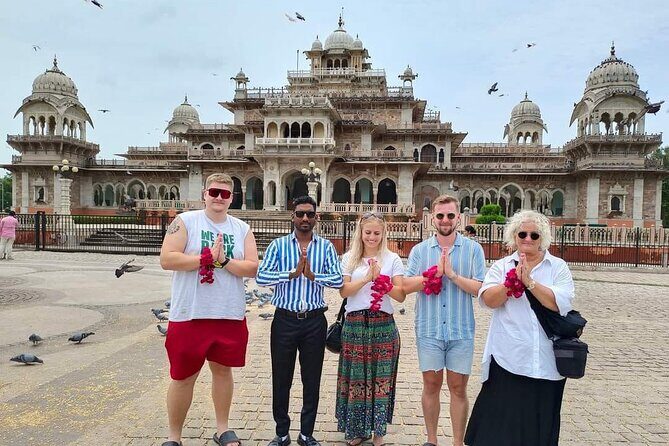
The tour also includes the Albert Hall Museum, described as the oldest museum in the state and functioning as the state museum of Rajasthan. The building is in Ram Niwas’s garden outside the city wall, opposite New Gate, and it’s known for Indo-Saracenic architecture.
If you like your travel days to include at least one “slow” indoor experience, this fits nicely. It’s also a great place to appreciate how British-era civic architecture in India blends styles—your eyes can follow the building’s details even if you don’t spend hours inside.
Galta Ji Temple: a pilgrimage site with spring water
One of the most distinctive stops is Galta Ji, about 10 kilometers from Jaipur. It’s an ancient Hindu pilgrimage site built into the crevice of hills surrounding the city, with natural spring water flowing down and filling sacred kunds (water tanks).
This is one of those experiences where you feel the site’s purpose. Pilgrims bathe in the tanks, and you can also ascend further up to a hilltop temple with views over the valley floor and Jaipur’s fortifications.
There’s also a legend attached: that Saint Galav lived, meditated, and did penance here. Even if you don’t care about legends, the setting is dramatic and the water element makes it more than a typical temple visit.
Practical tip: If you’re sensitive to crowded religious spaces, keep your expectations flexible. It’s a working pilgrimage site, not a timed photo set.
Optional Jaipur markets after sightseeing: shop with a local route
If you want more than monuments, the tour can take you to famous markets after sightseeing. The shopping focus is practical: fabrics, sandals, bags, and more, with an emphasis on low prices and good quality.
A guided route is helpful here because Jaipur markets can be confusing if you’re trying to find a specific item. Also, a driver/guide can steer you away from the places that waste time.
Smart approach: shop with a list. Decide what you’re buying first, then browse. That keeps the market stop from eating your entire afternoon.
Price and value: $13.59 per group plus monument entrances
At $13.59 per group (up to 3), the base price is low for a full-day private car experience. You’re not paying per person for the transport; you’re paying per group. That’s a big value lever if you’re traveling with friends or family.
But the real cost picture includes what’s not included:
- Combined entrance fees for Jaipur’s popular tourist monuments: $30 per person
- Camera fees at monuments (extra)
- Tips (recommended)
So a realistic “all-in” budget for three people often looks like:
- Base tour: $13.59 once per group
- Monument entries: about $30 x 3 = $90
- Then add camera fees if you use one, plus tips
In other words: the headline price is the sweetener, and the monument fees are the main line item. If you’re the type who hates surprise costs, plan on that $30 per person.
What you’re getting for the money is a structured day: private transport, bottled water, fuel/parking/taxes covered, and a local guide, plus breakfast-morning energy with chai and snacks.
Pace, comfort, and what to expect during the day
This tour covers a lot of ground in a single day. That’s good if you want a “see the highlights” plan. It’s also why comfort matters.
Here’s how to set yourself up:
- Wear shoes you can walk in for steps, uneven stone, and markets.
- Carry water habits even though bottled water is included.
- If you choose the flower market, treat it as an early active block, not a casual stroll.
- Bring a light layer for morning shade at sites like stepwells and temple areas.
The good news: most major stops are tied together by a private car, so you’re not constantly relocating or waiting. The day feels organized—less chaos, more sightseeing.
Who should book this Jaipur tour, and who should skip it
Book this if:
- You want one driver-led, guided day that covers Jaipur’s core highlights.
- You like the idea of starting with a local flower market and ending with a temple experience like Galta Ji.
- You’re traveling as a small group (since the price is per group up to 3).
- You prefer a plan where someone handles the “where to next” part.
Consider skipping or choosing a lighter plan if:
- You get uncomfortable with long days and multiple walking segments.
- You dislike paying entrance fees on top of the base tour price.
- You want deep, slow time at just one or two monuments instead of seeing many.
Should you book it?
If you’re doing Jaipur for the first time and you want to cover the Pink City’s major sights without logistics headaches, this is a strong choice. The combination of a private AC car, a guide, and a morning local market stop makes it feel like more than a checklist tour.
I’d book it especially if you’ll pick the 7:00–8:00 flower market slot and you’re okay with a full day pace. Just budget for the monument entrances and wear shoes for steps—do those two things and your day should run smoothly.
FAQ
What’s the meeting point for this tour?
The tour starts in Jaipur, Rajasthan, India. Pickup and drop-off are included from your hotel or other Jaipur location.
Is pickup and drop-off included?
Yes. Pickup and drop-off are included, including hotel/airport/railway station pickup and drop.
Does the tour include the flower market visit?
Yes, but it depends on the time slot you choose. If you select 7:00 AM to 8:00 AM, the tour takes you to the flower market.
How long is the Jaipur city tour?
The duration is approximately 9 to 10 hours.
What’s included in the price?
The tour includes bottled water, private transportation, fuel/parking/taxes, a local tour guide, and complimentary tea/coffee/lassi with snacks (samosa or kachori).
Are monument entrance fees included?
No. The combined entry fees for Jaipur’s popular tourist monuments are listed as $30.00 per person, and camera fees at monuments are also not included.
What if the weather is poor?
The experience requires good weather. If it’s canceled due to poor weather, you’ll be offered a different date or a full refund.